Cone Tapered Flagpoles
An overview of the cone taper design used on commercial aluminum flagpoles, including the optional entasis taper.
Nearly every commercial aluminum flagpole sold in the United States uses a cone taper design — a straight, linear taper that narrows the shaft from a wider butt diameter at the base to a smaller top diameter. The result is a pole that is strongest where bending stress is greatest (at the base) and lightest where stress is lowest (at the top).
Cone Taper Design
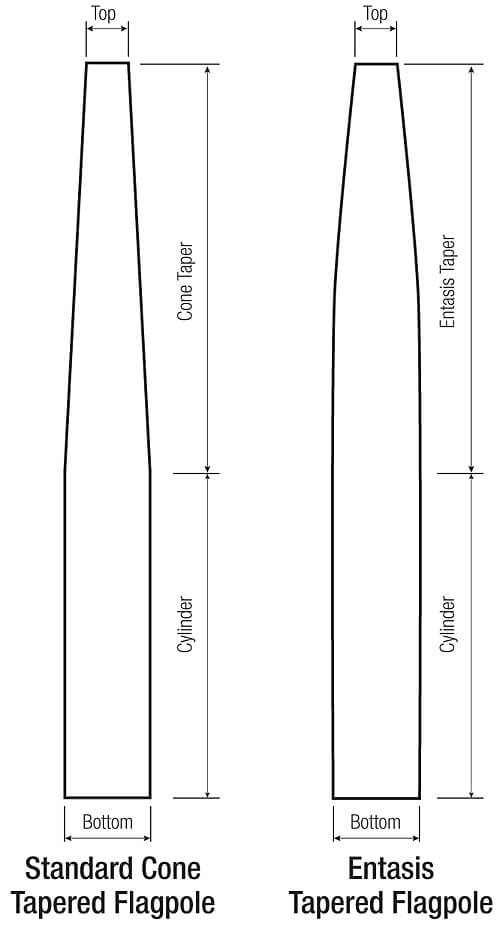
A cone tapered flagpole is built from spun aluminum tubing that narrows uniformly along its length. The taper is straight — the shaft's diameter decreases linearly from the butt diameter at the base to the top diameter at the peak.
This profile is both structural and visual:
- Structural efficiency. Wind load creates the largest bending moment at the base of the pole and almost none at the top. Concentrating material where it's needed produces a strong, lightweight shaft.
- Classical appearance. The clean, gently narrowing silhouette is the look most people picture when they think of a flagpole, and it has been the industry standard for decades.
- Consistent manufacturing. A straight taper can be produced reliably using shear-spinning processes, which keeps costs predictable across the full range of mounting heights.
Cone taper is the standard profile on virtually all commercial aluminum flagpoles.
Cylindrical and Tapered Sections
On most cone tapered flagpoles, the shaft is not tapered for its entire length. The lower portion of the pole is left cylindrical — a straight, non-tapered section that runs from the base up to where the taper begins. The taper then continues uniformly from the top of the cylindrical section to the top of the shaft.
The length of the cylindrical section varies by mounting height. Taller flagpoles typically have a longer cylindrical base, which adds bending strength in the area that carries the greatest load. The full set of cylindrical and taper lengths for a given model are published on the product page and are also the key inputs to our flagpole wind load calculator.
In a multi-piece flagpole, the lower piece is usually entirely cylindrical and the upper piece (or pieces) contains the tapered portion of the shaft. Field-installed splice joints sit within the tapered section and are nearly invisible once assembled.
Entasis Taper Option
A pure straight taper can, under bright sky, appear to curve inward when viewed from a distance — a subtle optical illusion that makes the pole look concave. Ancient Greek architects encountered the same effect on their stone columns and solved it by introducing a slight outward curve along the taper. The result is a profile that the eye reads as perfectly straight. This curved taper is called an entasis taper, and it is most famously visible on the columns of the Parthenon.
Most major aluminum flagpole manufacturers offer an entasis taper as a special-order option on their standard flagpole designs. The difference is subtle — most observers won't consciously notice it — but on tall flagpoles, or flagpoles installed at prominent civic and architectural sites, the entasis profile gives the pole a more refined, intentional appearance.
An entasis taper does not change the flagpole's wind rating, mounting requirements, or available finishes. Contact us if you would like to specify an entasis taper for your project.

The columns of the Parthenon use an entasis taper — a slight outward curve that corrects the optical illusion of a straight taper appearing concave.