Flagpole Finder
Find the right commercial flagpole for your project in six guided steps — we'll match your design wind speed, flags, mounting height, and structural specs to every flagpole that fits.
Choose your Design Wind Speed. Any flagged flagpole that does not meet your Design Wind Speed will be removed from the results.
Quick Select:
Design Wind Speed is the 3-second gust wind speed in miles per hour at 33 ft above ground level — the Allowable Stress Design wind speed (VASD). We use the ASD value because it's the basis for the maximum wind speed rating published for each flagpole, so the comparison stays apples-to-apples. If your plans specify a different figure, enter it manually.
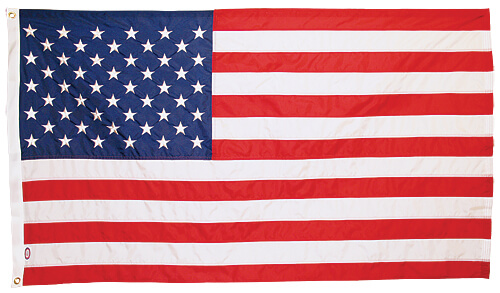
Choose the flag(s) for your flagpole.
Next, choose the type of flagpole you need.


Choose the mounting height for your flagpole. This is the height of the flagpole from the ground to the top of the flagpole.

Choose the butt diameter for your flagpole. This is the diameter of the bottom of the flagpole.
Tip: Larger butt diameters carry higher wind ratings.

Finally, choose the wall thickness for your flagpole. This is the thickness of the wall of the flagpole.
Tip: Choose the thinnest wall available (e.g. 0.125 inch) for the most economical option.
How we determine wind speed: for your ZIP code, we recommend the most stringent (highest) ASCE 7 design wind speed across the 7-10, 7-16, and 7-22 editions, at Risk Category II. For Risk Category III or IV, enter your design wind speed manually. Need help? Call (800) 526-8183 or email support@flagdesk.com and one of our flagpole specialists will help you choose the right flagpole for your project.
About the Flagpole Finder
The Flagpole Finder is Flag Desk's free interactive tool that matches your project's specifications to the right commercial flagpole in six quick steps. In about a minute, you go from "I need a flagpole" to a side-by-side comparison of every model that meets your wind, height, and structural requirements.
Whether you're a facility manager spec'ing a flagpole for a new building, an architect drafting a site plan, a contractor sourcing for a municipal project, or a homeowner upgrading the front of your property, the Flagpole Finder removes the guesswork from a decision that has to balance code compliance, durability, and budget.
Why we built it
Selecting a commercial flagpole means weighing several technical specifications at once. The flagpole has to withstand the design wind speed for your geographic location while flying the flag(s) you intend to display. It needs the right mounting height for the property, the right butt diameter and wall thickness to carry the load, and the right halyard system for how it will be operated and secured. Get any one of these wrong and you risk an undersized pole that bends in a storm or an oversized one that costs thousands more than you needed to spend.
Traditionally, this required either calling a flagpole specialist or wading through dozens of spec sheets. The Flagpole Finder distills that expertise into a guided flow that makes the right answer obvious.
How it works — the six steps
Each step asks one focused question, and your answer narrows the field of eligible flagpoles for the next step. By the time you reach the results, only flagpoles that satisfy every criterion are shown.
Design Wind Speed
The first and most important step is the design wind speed your flagpole needs to withstand. Enter a city, state, or ZIP code and Flag Desk looks up the design wind speed for that location automatically — comparing the 7-10, 7-16, and 7-22 editions of the ASCE 7 standard and recommending the most stringent (highest) value, at Risk Category II. You can also enter the speed manually or pick a common value (85 mph, 90 mph, 100 mph, all the way up to 170 mph). An interactive map shows wind speed zones across the U.S. for context.
Flags
How many flags will the flagpole fly, and what material? You'll choose between One Nylon Flag (the most popular, lightweight enough to fly in a light breeze), One Polyester Flag (heavier and more durable for sustained windy conditions), or Two Flags (a U.S. flag plus a state, military, or custom flag below it).
The Finder uses this to compare against each model's published maximum wind speed under that exact loading.
Flagpole Type
Choose the halyard system — how the flag is raised and lowered.
- External Halyard flagpoles are the most economical and use a rope on the outside of the pole.
- Internal Halyard Cam Cleat flagpoles hide the rope inside the shaft behind a lockable access door for added security.
- Internal Halyard Winch flagpoles use a stainless-steel cable and a gear-driven winch — the standard choice for taller commercial installations.
Mounting Height
The above-ground height of the flagpole, from 15 ft to 100 ft. Residential properties typically choose 20–30 ft; commercial buildings often go 30–50 ft; and large open commercial sites can go 60 ft or more.
Butt Diameter
The diameter of the flagpole at its base — the thickest point. Larger butt diameters carry higher wind ratings, and they typically scale with mounting height.
The Finder only shows you butt diameters that exist for your selected height and type. Not sure? Choose Skip to compare all viable diameters in the results.
Wall Thickness
The thickness of the aluminum tube wall, from 0.125" (1/8") up to 0.500" (1/2"). A thicker wall raises the flagpole's wind rating and structural strength but also increases weight and cost.
Choosing Skip compares every viable wall thickness so you can see the trade-off between price and headroom on wind rating.
Your results
Once you've made all six selections, the Flagpole Finder displays a side-by-side comparison table of every commercial flagpole that meets or exceeds your criteria. For each model you'll see the live price, brand, mounting height, butt diameter, wall thickness, pole sections, set depth, top diameter, key features, and the maximum wind speed rating with the exact flag configuration you chose. Click View on any model to see full product details and add it to your cart.
If no flagpoles match, the Finder tells you which constraints are too tight and lets you jump back to a specific step to relax them. You can also click any breadcrumb at the top of the tool to revisit an earlier step without losing your other selections, or click Start Over to begin a new search.
Behind the scenes
The Flagpole Finder is powered by a curated index of every commercial-grade flagpole Flag Desk stocks from manufacturers like Concord American and Eder. Each model's published wind ratings (with one nylon flag, one polyester flag, two flags, and unflagged) and physical specifications are loaded into the Finder so the comparison is always apples-to-apples and always against current inventory.
Wind speeds come from the ASCE 7 standard — the same data structural engineers and code officials design to. We store the design wind speed for every ZIP code across the 7-10, 7-16, and 7-22 editions and recommend the most stringent value at Risk Category II, so the number you start with is conservative and consistent with the building plans. If your project was designed for Risk Category III or IV, you can enter that wind speed manually.
When to use the Flagpole Finder
- Specifying for a new project — Get a list of code-compliant options before you write the spec.
- Replacing a damaged or undersized flagpole — Make sure the replacement is rated for the wind speed at the site, not just the model that was originally there.
- Budget planning — Compare pricing across brands and configurations side by side without scrolling through dozens of product pages.
- Comparing finishes & sections — Drill into the details that matter for shipping, installation, and longevity.
Get started
Have questions or need help interpreting your results? Call us at (800) 526-8183 or email support@flagdesk.com and one of our flagpole specialists will help you choose the right flagpole for your project.